

Root Canal Treatment – Endodontics
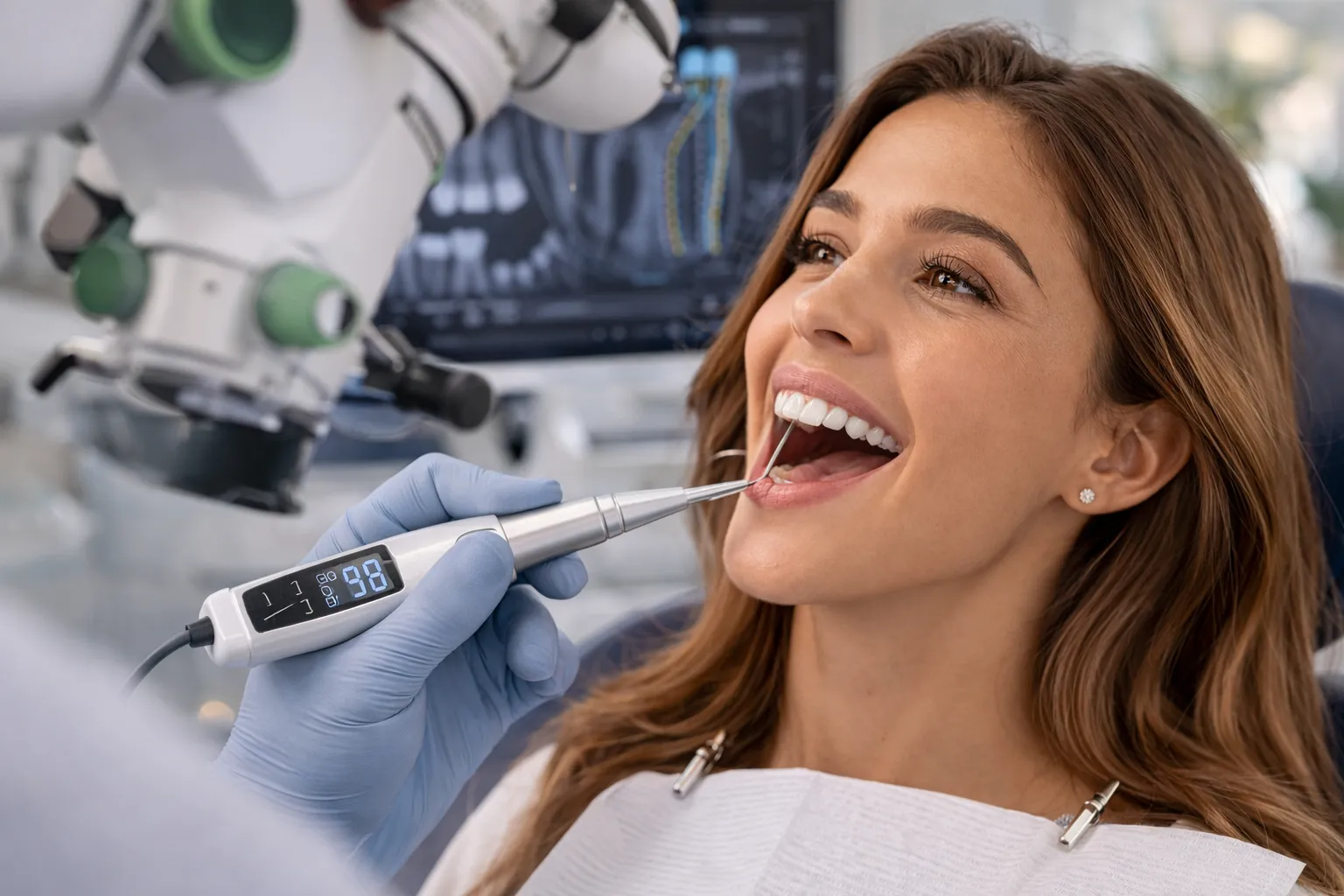
What Is Endodontics? Why Is Root Canal Treatment Necessary?
Endodontics is the dental specialty concerned with the disease and treatment of the pulp tissue — the innermost layer of the tooth — and the surrounding tissues. The pulp comprises soft tissue consisting of nerves, blood vessels and connective tissue, and is located within canals extending to the root tip of the tooth.
Bacteria reach the pulp as a result of deep decay, tooth fracture or repeated dental procedures. If left untreated, this can lead to severe pain, abscess and bone loss. Root canal treatment (endodontic treatment) is the procedure of removing the infected or damaged pulp, disinfecting the canals and filling them with a biocompatible material. The aim is always the same: to preserve the tooth without extraction.
Symptoms Indicating Root Canal Treatment
The following symptoms indicate that the pulp may be infected or damaged. If one or more of these symptoms are present, it is important to consult a dentist without delay. The earlier the treatment is performed, the higher the chance of saving the tooth.
Pain that continues even after the hot or cold contact is removed is a sign of pulp inflammation.
Severe pain that starts spontaneously without a trigger may indicate pulp necrosis.
Pus accumulated at the root tip manifests itself as swelling and pain in the gum.
Teeth that have lost their vitality gradually take on a grey or blackish colour over time.
Inflammation at the root tip can cause pain when pressure is applied to the tooth.
Chronic infections sometimes progress without pain and are detected on routine X-ray.
How Is Root Canal Treatment Performed?
Modern root canal treatment is performed under local anaesthesia, completely painlessly. Most patients state that the treatment is much more comfortable than expected. The procedure is generally completed in 1–2 sessions; each session takes an average of 45–90 minutes.
The anatomy of the canals, extent of infection and surrounding bone condition are evaluated with a periapical X-ray (CBCT when necessary). Correct diagnosis is the foundation of successful treatment.
The area is numbed with local anaesthesia. The tooth is isolated from saliva with a rubber dam, creating a sterile and dry working area. This step is critical for infection control.
Access to the pulp tissue is gained through an access cavity opened at the top of the tooth; the infected or dead pulp tissue is completely removed.
The canals are shaped and widened throughout their length with special rotary nickel-titanium instruments. These instruments adapt to the canal anatomy and perform the procedure without risk of fracture.
The canals are comprehensively irrigated with antibacterial solutions (sodium hypochlorite, EDTA) to remove bacteria and tissue debris. Effectiveness can be increased with ultrasonic activation.
The canals are filled three-dimensionally with gutta-percha and sealer (obturation). At this stage, the canals are completely sealed to prevent renewed bacterial entry.
After the procedure is completed, a temporary or permanent filling is placed. For long-term protection of root canal-treated teeth, a crown (restoration) is usually recommended.
Retreatment of Previous Root Canal Treatment
A tooth that has previously had root canal treatment may become re-infected in certain circumstances. This can occur due to inadequate initial treatment, new decay formation, leakage from the filling or crown, or undetected canal anatomy.
Retreatment is the procedure of removing the existing canal filling, reshaping and re-disinfecting the canals and placing new filling. Signs indicating root canal treatment failure include: pain continuing after treatment, swelling on the gum, root tip lesion seen on X-ray and presence of abscess.
Patients whose pain has not resolved after root canal treatment, who have developed a new abscess, who show a root tip lesion on X-ray, or whose previous filling is found to be inadequate.
With correct indication and experienced application, the retreatment success rate is around 70–85%. Effectiveness close to the initial root canal treatment is achieved.
Retreatment is usually attempted first; if it fails, apical resection (surgery) is planned. The decision is made based on lesion size and anatomy.
At our clinic, renewal of failed root canal treatments performed at other centres is applied with great care and precision.
Apical Resection (Root-End Surgery)
This is a surgical endodontic method used as a last resort in the presence of a chronic cyst or persistent infection at the root tip that cannot be resolved with root canal treatment or retreatment. It is also known as apicoectomy or root-end resection.
Apical resection, with appropriate indications, is the last endodontic option that preserves the tooth without extraction, with high success rates. Mild swelling and sensitivity for 1–2 days after the procedure is normal.
Non-Vital Bleaching – Tooth Whitening After Root Canal Treatment
Front teeth that have had root canal treatment can develop a grey, yellow or brownish colour over time. This occurs because blood pigments and the canal filling materials used penetrate the inner surface of the tooth following the removal of the pulp. It creates a noticeable aesthetic concern, particularly in the front tooth region.
Non-vital bleaching is a method applied specifically to root canal-treated teeth in which the tooth is whitened from the inside. Unlike classic external whitening; the whitening agent is placed directly into the pulp chamber.
This method, which is rarely addressed as a separate section at competing clinic sites, is offered at our clinic as the aesthetic complement to root canal treatment.
What to Watch Out for After Root Canal Treatment
After root canal treatment is completed, mild sensitivity and pain may be experienced for a few days. This is completely normal and is controlled with prescribed painkillers. Paying attention to the following points speeds up the healing process and preserves the long-term success of the treatment.
| First 24–48 Hours | First 1 Week | Long Term |
|---|---|---|
| Avoid hard foods and foods requiring chewing | Avoid chewing excessively on the treated side | At least 2 dental check-ups per year |
| Take prescribed antibiotics/painkillers | Continue regular brushing and flossing | Crown recommended for fractured, long-term resistant teeth |
| Avoid smoking | Contact us immediately if swelling increases | Book an appointment for any recurrence of pain or swelling |
Crown Application After Root Canal Treatment
Root canal treatment eliminates the infection in the tooth; however it does not complete its structural protection. Coronal restoration is essential for long-term success. The most common and reliable option is a crown application.
| Situation | Recommended Restoration | Description |
|---|---|---|
| Front tooth, minimal tissue loss | Composite filling or veneer | Aesthetics-focused, protection may be sufficient |
| Front tooth, colour change | Non-vital bleaching + composite / E.Max crown | Whitening first, filling if sufficient |
| Back tooth (premolar) | Zirconia or E.Max crown | Crown mandatory due to chewing load |
| Back tooth (molar) | Zirconia crown | Maximum protection, crown strongly recommended |
| Very little tooth tissue remaining | Post-core + zirconia crown | Substructure reinforcement may be required |

Dr. Sevgi Savaş Akbaş
Dentist · Endodontics · Retreatment · Ankara İncekDr. Sevgi Savaş Akbaş applies all endodontic treatments at her Ankara İncek clinic — including root canal treatment, retreatment, apical resection and non-vital bleaching — with modern equipment and up-to-date protocols. Each case is managed to the highest success standard with rubber dam isolation, rotary system use and CBCT-supported diagnosis. She also has experience in retreatment of root canal treatments that have failed at other centres.
Root Canal Treatment – Frequently Asked Questions
Is root canal treatment painful?
How many sessions does root canal treatment take to complete?
How long does a root canal-treated tooth last?
What is the difference between retreatment and root canal treatment?
What is non-vital bleaching and which teeth is it applied to?
Why is a crown recommended after root canal treatment?
What is apical resection and when is it necessary?
What should I do if pain persists after root canal treatment?
What is a rubber dam and why is it used?
Is root canal treatment a better option than extraction?
Is root canal treatment risky?
Why Sevgi Savaş Dental Clinic in Ankara İncek for root canal treatment?
Let Us Save Your Tooth Without Extraction
If you are experiencing tooth pain, swelling or colour change, book an assessment appointment without delay. Let us take the right step together to protect your tooth.
📞 Call Now 💬 WhatsApp Ankara Dental Clinic →