

Removable Prostheses
What Is a Removable Prosthesis?
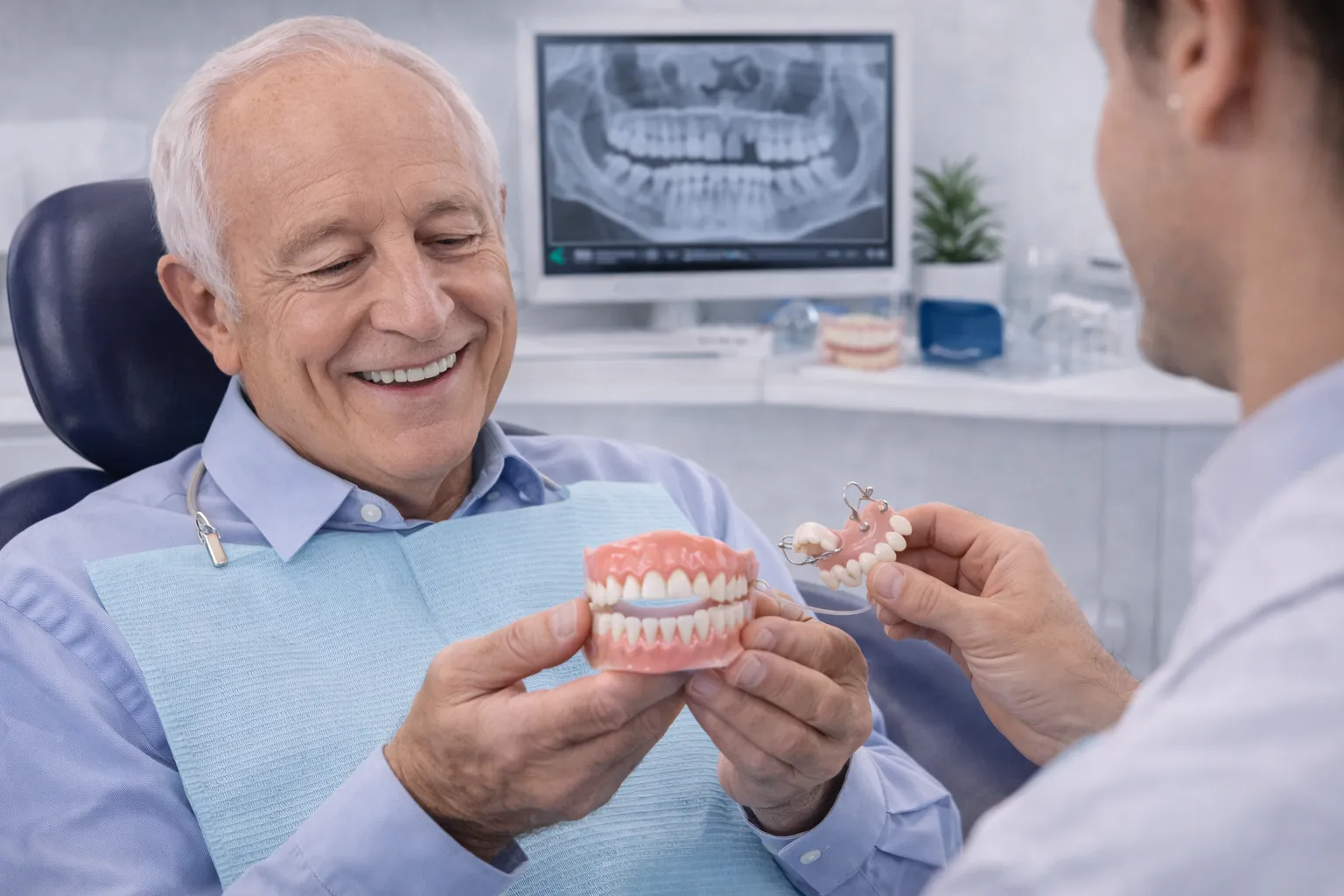
Removable prostheses are artificial teeth that replace missing teeth and can be inserted and removed daily by the patient. Their fundamental difference from fixed prostheses (crown, bridge, implant) is that they are not permanently attached to the tooth or jawbone. They rest on soft tissues, remaining natural teeth or implants for retention.
Complete Denture (Full Denture)
A complete denture is the removable prosthesis used in complete edentulism where no natural teeth remain in the mouth. It is commonly known as "false teeth" or "plate denture." It is prepared separately for the upper and lower jaw; each one is custom-made to the patient's oral measurements.
The upper complete denture is retained by vacuum effect thanks to the wide acrylic base covering the palate. The lower complete denture is less stable than the upper prosthesis due to its narrower base area; adaptation may take longer.
The wide palatal surface provides a vacuum effect; retention is stronger than the lower denture. As it covers the palate, a sense of unfamiliarity may occur initially; taste perception may change slightly.
Adaptation is more difficult due to the narrow bony ridge and mobile tongue-lip muscles. It settles more firmly over time with tongue exercises and swallowing movements.
Aesthetics close to a natural tooth appearance are achieved. Lip and cheek support is restored; the feeling of facial collapse is reduced. Speech and chewing function gradually returns to normal.
When there are no teeth in the jaw, the bone gradually begins to resorb. A complete denture does not prevent this resorption; however it provides facial support. An implant-supported prosthesis is far superior in terms of bone preservation.
Due to changes in the jawbone shape, the denture gradually no longer fits the mouth. Renewal or rebasing every 3–5 years may be required. Managing a loose denture with adhesive in the long term accelerates bone loss.
Partial Denture (Clasp Denture)
A partial denture is the type of removable prosthesis that completes missing teeth while some natural teeth remain in the mouth. Artificial teeth are placed on a metal or acrylic base; they are retained on the remaining natural teeth with metal clasps. It is commonly known as a "clasp denture."
Precision Attachment Prosthesis (Clasp-Free / Aesthetic Attachment)
A precision attachment prosthesis is a type of partial prosthesis that uses hidden connection systems embedded in the tooth or crowns instead of clasps (metal hooks). It is also known as a "snap-on denture"; half of the attachment mechanism is inside the abutment tooth, and the other half is inside the prosthesis. It clicks into place when closed.
Implant-Supported Removable Prosthesis
An implant-supported removable prosthesis is a type of prosthesis in which 2–4 implants are placed and the prosthesis rests on these implants while still being removable by the patient. Slipping and movement, which is one of the most important problems of classic complete or partial dentures, is largely resolved with implants.
Its difference from a fixed implant-supported prosthesis is that this prosthesis can be removed daily by the patient. The implants remain fixed in the mouth; the prosthesis is inserted onto and removed from the connection systems on the implants.
Immediate (Temporary) Prosthesis – Aesthetics Right After Extraction
An immediate prosthesis is a temporary removable prosthesis that is fitted in the same session immediately after tooth extraction when extraction is planned. It prevents the patient from appearing toothless; it provides aesthetic and basic chewing support throughout the healing period.
Which Prosthesis for Which Situation?
| Situation | Recommended Prosthesis | Why? |
|---|---|---|
| All teeth missing, good bone | Complete + implant-supported | Most comfortable and stable solution |
| All teeth missing, declines implant | Complete denture | Surgery-free, economical |
| Some teeth missing, aesthetics not a priority | Partial (clasp) denture | Economical and functional |
| Some teeth missing, aesthetics a priority | Precision attachment prosthesis | No visible metal, comfortable |
| Wearing complete denture but it slips | Implant-supported removable | Stability with 2–4 implants |
| Extraction imminent, doesn't want to be toothless | Immediate (temporary) prosthesis | Fitted the same day as extraction |
| Bone unsuitable for implant or bridge | Removable prosthesis | Most comprehensive surgery-free solution |
Which prosthesis is appropriate is determined together following clinical examination based on bone structure, the condition of remaining teeth, patient expectations and general health status.
The Prosthesis Adaptation Process – What to Expect
When a removable prosthesis is first fitted, a foreign body sensation in the mouth, increased saliva and difficulty speaking are perfectly normal. These symptoms gradually decrease and disappear throughout the adaptation process.
The mouth recognizes the new object as "foreign"; saliva production increases. This is completely normal and will pass.
Pronouncing some sounds may become difficult. Reading aloud and repeating challenging words shortens the process.
Start with soft foods first; chew equally on both sides. Gradually progress to harder foods.
Speech returns to normal, chewing confidence increases. The lower prosthesis may take longer to adapt to than the upper.
Removable Prosthesis Care and Lifespan
Although the lifespan of removable prostheses is 5–8 years, regular care and check-ups extend this period. Loss of fit may occur due to changes in the jawbone; rebasing or renewal may be required.
Remove the prosthesis and clean it under running water with a soft brush and liquid soap. Do not use toothpaste; the abrasives in it scratch the prosthesis surface and cause discoloration.
Removing the prosthesis at night rests the oral tissues. Leaving it in a dry environment can deform the prosthesis; store it in water or in damp special containers. You can add a cleaning tablet 1–2 times a week.
Place a wet towel over the sink or hold it over a water-filled container while cleaning. Acrylic prostheses can break on impact. Do not attempt to repair a broken prosthesis with adhesive; bring it to the clinic.
Do not bite walnut shells, ice or hard bread crusts with the prosthesis. Excessive force breaks the prosthesis or damages the abutment teeth.
A check-up every 6 months evaluates the fit of the prosthesis, the health of the abutment teeth and gum condition. If loosening is felt, the fit is renewed with a rebase procedure.
If the prosthesis is worn, broken, slipping or difficulty chewing has increased, it is time for renewal. Routine assessment every 5–8 years is recommended. Rather than continuing to rely on adhesive, consult your clinic.
Dr. Sevgi Savaş Akbaş
Dentist · Prosthodontics · Removable Prosthesis · Ankara İncekDr. Sevgi Savaş Akbaş plans complete denture, partial, precision attachment and implant-supported removable prosthesis solutions at her Ankara İncek clinic in a personalized manner according to each patient's bone structure, aesthetic expectations and general health status. A comprehensive range of treatments from immediate prostheses to long-term implant-supported solutions is offered, with close follow-up provided throughout the adaptation process.
Removable Prosthesis – Frequently Asked Questions
Is a removable prosthesis the same thing as false teeth?
How long does it take to adapt to a prosthesis?
How often should a prosthesis be renewed?
What is the difference between a precision attachment and a clasp denture?
What is the difference between an implant-supported removable and a fixed implant prosthesis?
Should the prosthesis be removed at night?
Can toothpaste be used to clean a prosthesis?
Why is an immediate (temporary) prosthesis not permanent?
Is having an implant better than a removable prosthesis?
My prosthesis has started to slip — what should I do?
Why Sevgi Savaş Clinic in Ankara İncek for removable prostheses?
Book an Appointment for Removable Prosthesis Assessment
Let us determine your complete, partial, precision attachment or implant-supported prosthesis option with a personalized examination at our Ankara İncek clinic.
Call Now WhatsApp Ankara Dental Clinic