

Implant-Supported Prostheses
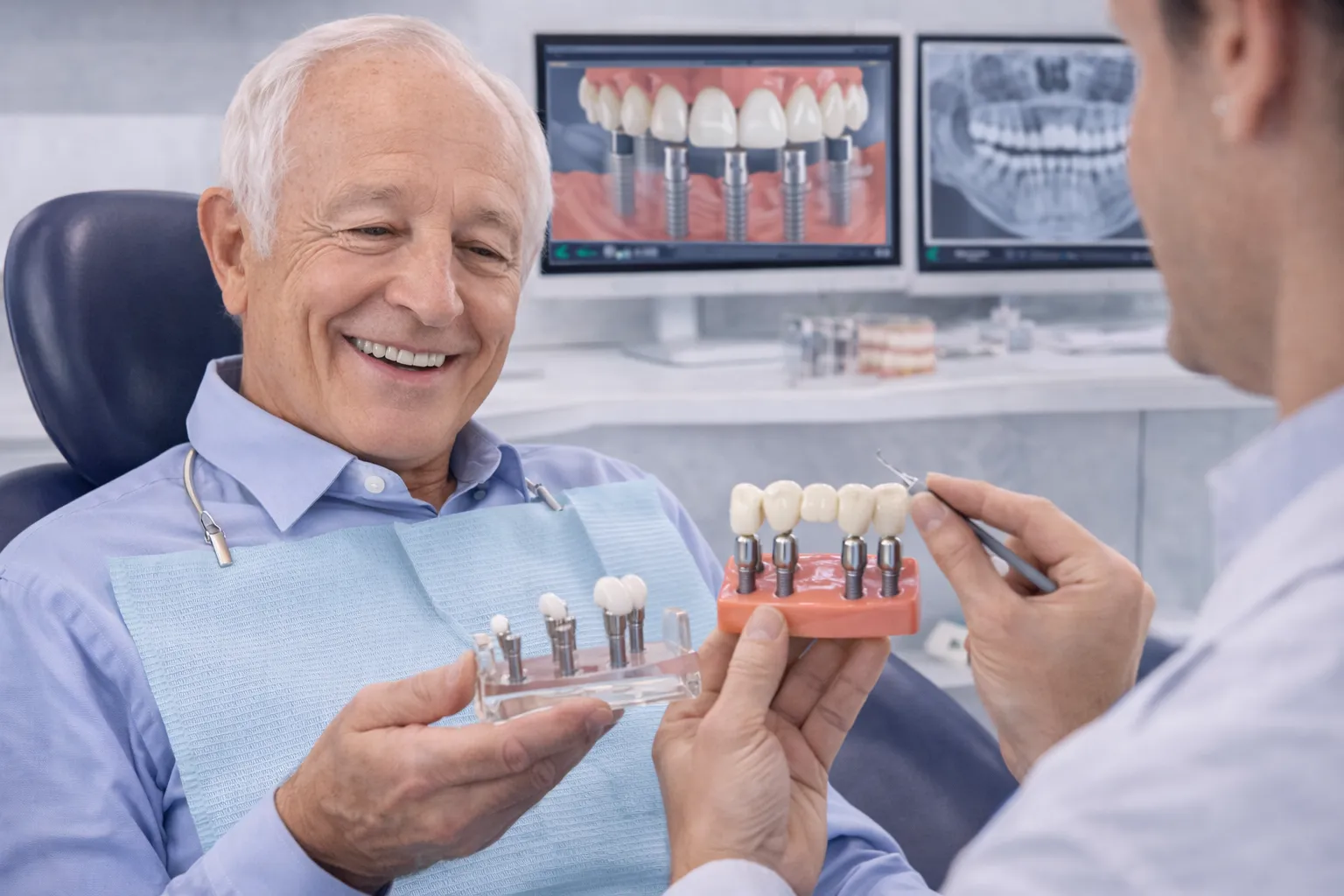
What Is an Implant-Supported Prosthesis? What Is an Abutment?
A dental implant system consists of three parts: the titanium screw placed in the jawbone (artificial root), the abutment (intermediate connector piece) that connects the screw to the prosthesis, and the prosthesis (crown, bridge or full-jaw prosthesis) visible at the top.
The abutment is the critical component that determines how the prosthesis sits on the implant and the method by which it is secured. It can be produced from titanium or zirconia; zirconia abutments are aesthetically preferred for front teeth as they do not create a grey reflection at the gum margin.
Fixed Cemented Implant-Supported Prosthesis
A cemented prosthesis consists of fixed crowns permanently bonded to the abutment with adhesive (cement). It cannot be removed by the patient; it can only be detached by the dentist, usually by cutting the prosthesis. It is the most common option for single tooth and short bridge applications.
Highest natural tooth sensation · Perfect in terms of comfort and aesthetics · Abutment screw is invisible; upper surface is completely covered · Gold standard for single teeth and short bridges
Prosthesis may need to be cut for maintenance or repair; this incurs cost · Requires a large number of implants in complete edentulism cases · Special tools (superfloss) are essential for under-bridge cleaning
Single tooth or a few missing teeth · Cases requiring perfect aesthetics in front teeth · Partial edentulism requiring bridge prosthesis · Angulation problems where screw-retained system is not suitable
Brushing twice daily · If bridge present, under-bridge cleaning with superfloss · Interdental brush and oral irrigator are recommended complements · 6-monthly clinical check-up
Screw-Retained / Hybrid Fixed Prosthesis
In a screw-retained (hybrid) prosthesis, the prosthesis is secured with a screw rather than being bonded to the abutment. This screw access hole passes through a small channel in the chewing surface of the prosthesis; it is invisible during use. The dentist can easily remove and reattach the prosthesis via the screw.
Toronto Prosthesis – Fixed Sensation in Complete Edentulism
A Toronto prosthesis is a special type of prosthesis screwed onto 4–6 implants in complete edentulism cases, offering comfort very close to a fixed prosthesis. It cannot be removed by the patient; it is removed and refitted by the dentist using the screw-detachment method for periodic maintenance.
Toronto prostheses with acrylic or zirconia framework replace the entire front-to-back tooth series in a single piece. They are frequently applied with All-on-4 and All-on-6 concepts.
Implant-Supported Removable Prosthesis
An implant-supported removable prosthesis is a type of prosthesis that rests on 2–4 implants and can be removed daily by the patient. The slipping and movement that is the biggest problem of a classic complete denture is largely resolved with implant support. It is the ideal option when full comfort is desired but surgical load is to be reduced.
All-on-4 / All-on-6 – Same-Day Fixed Teeth in Complete Edentulism
All-on-4 and All-on-6 concepts are modern full-jaw rehabilitation systems in which temporary fixed prostheses are fitted on 4–6 implants on the same day as the surgical operation in patients with all teeth missing or requiring extraction. The permanent prosthesis is applied after osseointegration is complete.
| Feature | All-on-4 | All-on-6 |
|---|---|---|
| Number of implants | 4 (2 straight + 2 angled) | 6 (4 straight + 2 angled) |
| Mechanical stability | High | Very high |
| Bone graft requirement | Usually not required | Usually not required |
| Same-day temporary teeth | Yes | Yes |
| Permanent prosthesis timing | After 3–6 months | After 3–6 months |
| Bone resorption | Applicable in moderate resorption | Requires slightly more bone |
| Long-term advantage | Good | Higher support |
In both systems, angled (tilted) implants bypass the sinus region, eliminating the need for additional sinus surgery in the upper jaw in most cases. Suitability is determined with 3D tomography.
Material Selection for Implant-Supported Prostheses
| Material | Area of Use | Advantage | Disadvantage |
|---|---|---|---|
| Porcelain (E.max) | Single tooth, front region crown | Highest light transmittance, natural appearance | High fracture risk in back teeth |
| Zirconia | Single tooth, bridge, full-arch | Durability + aesthetic balance; no metal | Porcelain layer can chip in layered version |
| Monolithic Zirconia | Back teeth, bruxism | Maximum durability; no fracture risk | Slightly less aesthetic |
| Acrylic (temporary) | Healing period prosthesis | Economical, quick to produce | Temporary; limited colour and wear stability |
| Hybrid (acrylic+metal) | Full-arch Toronto/All-on-4 | Lightweight, economical full-jaw restoration | Acrylic teeth may wear over time |
For a single-tooth implant, E.max is recommended for the front region and monolithic zirconia for the back region. In full-arch (full jaw) restorations, the choice between zirconia or hybrid is determined by bone structure, aesthetic expectations and budget.
Implant-Supported Prosthesis Application Process
Bone quality, sinus structure and nerve canals are assessed with 3D imaging; prosthesis option and number of implants are determined.
Implant positions are planned digitally; a surgical guide plate is produced to ensure precise placement.
Implants are placed in determined positions under local anaesthesia or sedation. Healing caps or temporary prosthesis are fitted.
2–4 months (sometimes 4–6 months for the upper jaw) are awaited; the implant fuses with the bone. A temporary prosthesis is used during this period.
Osseointegration is confirmed. The abutment (titanium or zirconia) is placed on the implant; 1–2 weeks of healing is awaited.
Abutment position is recorded; a personalized prosthesis design is made and sent to the laboratory.
The prosthesis is evaluated in the mouth with a trial session; occlusion, colour and aesthetics are approved. It is permanently fixed with cement or screw.
In All-on-4/6 cases, surgery and temporary prosthesis can be completed the same day; the permanent prosthesis is fitted 3–6 months later.
Implant-Supported Prosthesis Care
The implant body does not decay; however the surrounding bone and gum can be damaged with insufficient care. Peri-implantitis (inflammation around the implant) is the leading cause of implant loss and is a preventable condition.
Brushing twice daily is mandatory. The implant-gum junction is particularly important; bacterial accumulation here can lead to peri-implantitis. A soft-bristled brush or electric toothbrush may be preferred.
The spaces between teeth and under the bridge in fixed bridge prostheses cannot be cleaned with regular dental floss. Use of superfloss (under-bridge floss), an interdental brush and an oral irrigator is essential.
Every night the prosthesis should be removed and first the inside of the mouth, then the prosthesis should be cleaned. Use a soft brush and liquid soap under running water; toothpaste scratches the surface. An effervescent tablet can be added 1–2 times a week.
Especially in full-arch and multi-unit bridges, the oral irrigator cleans areas unreachable by brush and floss. Start using on the low pressure setting. Very effective for peri-implant cleaning.
Every 6 months: screw torque, peri-implant bone level and gum health are assessed. For fixed screw-retained prostheses, annual removal and professional cleaning are recommended.
Teeth clenching causes significant damage to implant-supported prostheses. Masseter Botox and night guard use are mandatory for patients with bruxism; otherwise prosthesis and implant lifespan is shortened.
Dr. Sevgi Savaş Akbaş
Dentist · Prosthodontics · Implant-Supported Prosthesis · Ankara İncekDr. Sevgi Savaş Akbaş comprehensively offers implant-supported prosthesis applications at her Ankara İncek clinic with fixed cemented, screw-retained/hybrid, Toronto prosthesis and removable implant-supported options. Each case's bone structure, aesthetic expectations and usage habits are evaluated to determine material selection (zirconia / E.max / monolithic) and prosthesis type; high precision is ensured with digital implant planning and surgical guide.
Implant-Supported Prosthesis – Frequently Asked Questions
How many years does an implant-supported prosthesis last?
What is the difference between a cemented and a screw-retained prosthesis?
What is a Toronto prosthesis?
What is the difference between All-on-4 and All-on-6?
Should zirconia or porcelain be preferred for implant-supported prostheses?
Is care for an implant-supported prosthesis different from natural teeth?
What is peri-implantitis and how is it prevented?
Should I prefer a titanium or zirconia abutment?
Is implant-supported prosthesis application painful?
I have a teeth clenching habit — can I have an implant-supported prosthesis?
Why Sevgi Savaş Clinic in Ankara İncek for implant-supported prostheses?
Book an Appointment for Implant-Supported Prosthesis Planning
Let us determine the most suitable solution at our Ankara İncek clinic — from a single missing tooth to complete edentulism; from fixed cemented to All-on-4 Toronto prosthesis.
Call Now WhatsApp Ankara Dental Clinic