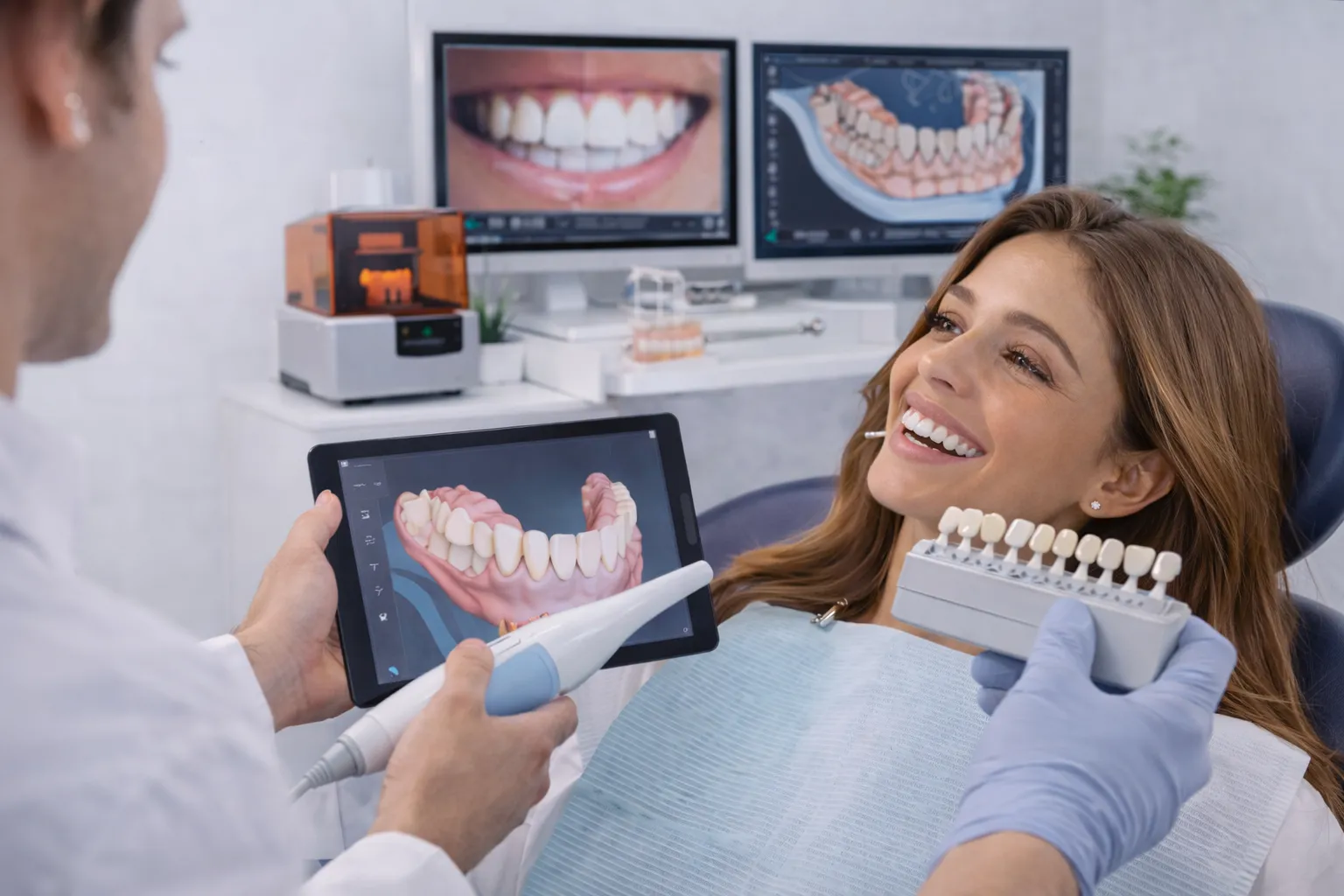
Ankara İncek · Advanced Technology
Digital Dentistry
Faster, more precise and same-day treatments with intraoral scanner, CAD/CAM, DSD and 3D planning. No gag reflex, no temporary teeth.
Same DayRestoration delivery (in a single session)
3DFull image with digital impression
ZeroGag reflex risk
CAD/CAMMicron-precision manufacturing
Digital dentistry is a modern dental approach in which computer-assisted technologies are used in diagnosis, planning and treatment processes. Instead of traditional plaster impression trays, intraoral scanners are used; instead of manual milling, CAD/CAM production; instead of hand drawing, digital smile design (DSD); and instead of X-rays, 3D tomography. The result is a shorter treatment period, higher precision, less patient discomfort and the ability to see the outcome before treatment is complete.
What is Digital Dentistry?
Digital dentistry is a computer-assisted dental practice in which digital devices and software are integrated into all or part of the diagnosis, planning and production stages. From a simple filling to complex implant planning, from smile design to orthodontic treatment, every application can now be carried out through a digital workflow.
| Area | Traditional Method | Digital Method | Patient Benefit |
|---|
| Impression taking | Plaster impression tray | Intraoral 3D scanner | No gag reflex, fast |
| Restoration production | Laboratory (7–10 days) | CAD/CAM (same day) | Delivery in single session |
| Smile design | Hand drawing / estimation | DSD software, virtual mirror | See the outcome in advance |
| Implant planning | Clinical exam + 2D X-ray | CBCT + 3D software + guide | Safer surgery |
| Orthodontics | Metal bracket + wire | Digitally measured clear aligner | Aesthetic, removable |
| Data storage | Plaster model, paper record | Digital data archive | Re-production capability |
Digital Impression with Intraoral Scanner
The intraoral scanner (in-mouth 3D camera), which replaces traditional impression trays, transfers the entire mouth to the computer with millimeter precision within seconds. The patient neither experiences a gag reflex nor has to keep their mouth open for a long time.
The 3D model obtained is used directly for smile design, restoration planning, implant positioning and orthodontic planning. The margin of error is minimal compared to a traditional plaster model; restoration fit is perfected.
Patient ComfortNausea and discomfort experienced with plaster impressions are completely eliminated. Scanning time is 2–5 minutes; there is no need to keep the mouth closed.
Millimeter Precision3D data contains far fewer errors than a manually prepared plaster model. The fit of restorations and prostheses on the tooth improves significantly; the risk of microleakage is reduced.
Instant Digital TransferWhen scanning is complete, the 3D model appears on screen; the dentist and patient can examine it together. Data is instantly transmitted to the CAD/CAM software or laboratory.
Storage in Data ArchiveAll scan data is stored digitally. If a restoration breaks or renewal is required in the future, production can be carried out from the same data without needing to take a new impression.
Computer-Assisted Production with CAD/CAM Technology
CAD/CAM (Computer-Aided Design / Computer-Aided Manufacturing) is the system in which crowns, veneers, inlays, onlays and bridge prostheses are produced by a computer-controlled milling machine starting from digital impression data.
CAD/CAM Workflow
Digital impression is taken and a 3D model is created · Restoration is shaped in design software · Sent to the CAM machine · Ceramic or zirconia block is milled · Staining/firing is done for color matching · Applied to the tooth in the same session or within a few hours
Difference from Traditional Laboratory
Traditional: 7–10 day laboratory process + use of temporary tooth · CAD/CAM: Delivery same day or in 1–2 days · Traditional: Human hand error is possible · CAD/CAM: Millimeter computer precision · Traditional: If plaster model is lost, re-impression required · CAD/CAM: Permanently stored in digital archive
Zirconia and ceramic restorations produced with CAD/CAM technology offer results equivalent to or superior to handmade restorations in terms of precise fit, tight marginal adaptation and long-term success rates.
Digital Smile Design (DSD)
Digital Smile Design (DSD) is an advanced aesthetic planning technology in which the smile is designed and shown to the patient in a virtual environment before treatment, by combining the patient's facial photographs and 3D scan data.
DSD Process
Facial and oral photographs + 3D scan · Tooth proportion and smile line analysis in software · Digital tooth design suited to facial structure · Patient sees the result on their own face via "virtual mirror" · Physical approval with mock-up (in-mouth trial) · Approved design is produced with CAD/CAM
Advantages of DSD
Patient expectations are clarified before treatment begins · Surprise results are eliminated · Smile line, tooth lengths, midline — all details adjusted in advance · Face-harmonious design created through visagist-dentist collaboration · Standard process in aesthetic smile design cases
Digital Implant Planning and Guided Surgery
In digital implant planning, the bone image obtained with 3D tomography (CBCT) is combined with the tooth/gum data taken from the intraoral scanner. This allows the size, angle and depth of the implant to be determined virtually before surgery.
When planning is complete, a surgical guide plate that ensures the implant is placed in exactly the planned position is produced with CAD/CAM. Thanks to guided surgery, much higher accuracy is achieved compared to the freehand technique.
Safety Provided by Digital Planning
Nerve canals and anatomical structures are viewed in 3D · Implant is placed without damaging neighboring structures · Optimum position with minimum bone removal · Soft tissue trauma reduced with the sutureless implant option · Patient can see the outcome before surgery
Flapless (Sutureless) Implant
Thanks to the digital guide, the implant can be placed without opening the gum · Healing process is accelerated; swelling and pain are reduced · Patient can leave the clinic the same day · All prerequisites are determined in the digital assessment
Digital Orthodontics – Clear Aligner
Clear aligner orthodontics is the fully digital alternative to the traditional bracket system. A personalized series of aligners is designed and produced using software based on the 3D impression taken with an intraoral scanner. The patient can see, in a digital simulation before treatment begins, how the teeth will be aligned step by step.
Advantages of the Digital Aligner Process
Impression is digital, not plaster; more comfortable · Each aligner codes the next movement in millimeters · Treatment simulation is seen in advance · Removable; free during eating and brushing · Oral hygiene is much easier than with bracket systems
Who Is It Suitable For?
Mild–moderate crowding and bite problems · Adults with high aesthetic concern · Those with active social or professional lives · Those who don't want the irritation and breakage risk of brackets · Those who prefer shorter control intervals
Single-Session Restoration – Same-Day Result
One of the most tangible patient advantages of digital dentistry is that restoration treatment can be completed in a single session. A procedure that required 2–3 sessions and 7–10 days of waiting in the traditional process can be completed within the same day with the CAD/CAM workflow.
1
Examination and PreparationThe condition of the tooth is assessed; necessary preparation is performed.
2
Digital ScanningA 3D impression is taken with the intraoral scanner in 2–5 minutes; no traditional plaster impression needed.
3
CAD/CAM DesignThe restoration is shaped in the software; compatibility with occlusion and neighboring teeth is checked.
4
Milling and Color ProcessingThe ceramic or zirconia block is shaped in the machine; color staining and firing are performed.
5
Trial and BondingThe restoration is tried in the mouth; fit, color and occlusion are checked; it is permanently bonded.
The patient comes to the clinic in a single session, uses no temporary tooth and leaves with a permanent restoration the same day.
Digital Inlay and Onlay Restorations
Inlays and onlays are ceramic restorations that preserve tooth tissue in cases of advanced caries or fractures where standard fillings are insufficient. While standard fillings are shaped outward, inlay/onlay are laboratory-produced pieces that fit precisely inside or on top of the tooth.
InlayApplied when caries or fracture is only on the inner surface of the tooth. Bridges the gap between a filling and a crown; conserves tooth structure. Can be completed in a single session with CAD/CAM.
OnlayApplied when caries or fracture extends to the cusps of the tooth. Requires less preparation than a crown; preferred for tissue conservation.
Advantage with CAD/CAMPerfect fit is achieved with digital impression; small inaccuracies inevitable in manual procedures are eliminated. Can be applied in a single session; no laboratory waiting.
Digital Data Archive – Your Measurements Are Stored Permanently
One of the lesser-known but extremely practical advantages of digital dentistry over traditional methods is that all production data is stored permanently in digital form.
What the Data Archive Provides
When a restoration breaks or renewal is needed, no new impression is required · New production is made from the same data; faster and more economical · A new series of orthodontic aligners is also produced from the same data · Provides convenience for repeat production of transparent bruxism splints or night guards · Virtual model is always accessible
Difference from Traditional Method
Traditional plaster model can break or be lost; re-impression is essential · Paper cards can be lost over time, color information can fade · Digital data: incorruptible, copyable and remotely accessible · If the clinic changes or the laboratory is updated, data can be transferred
Treatment Areas Where Digital Technology Is Used
Aesthetic Smile DesignSmile veneer or crown applications with DSD + mock-up + CAD/CAM. The result is seen before treatment.
Implant SurgeryCBCT + 3D planning + surgical guide. Sutureless or minimally invasive application.
Zirconia / E.max CrownRestoration delivery same day or in 1–2 days with CAD/CAM. No temporary tooth.
Orthodontics – Clear AlignerDigital impression + simulation. Correction without brackets in mild–moderate cases.
Inlay / OnlayDigital impression + single-session CAD/CAM restoration. Solution between filling and crown.
Bruxism and Night GuardPersonalized splint production with digital impression; no impression needed for repeat production.
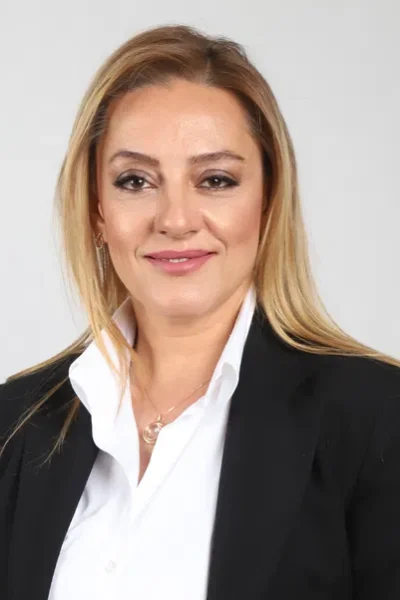
Dr. Sevgi Savaş Akbaş
Dentist · Digital Dentistry · CAD/CAM · DSD · Ankara İncek
Dr. Sevgi Savaş Akbaş uses intraoral 3D scanner, CAD/CAM production and Digital Smile Design (DSD) technologies in an integrated manner at her Ankara İncek clinic. Single-session restoration, digital implant planning, clear aligner orthodontics and aesthetic smile design supported by visagist analysis are all carried out through a digital workflow; the patient can see the treatment outcome before it begins.
Digital Dentistry – Frequently Asked Questions
What is a digital impression and how does it differ from a traditional one?
A digital impression is the transfer of teeth and gums to a computer with millimeter precision within seconds using an intraoral 3D scanner. In a classic plaster impression, the tray and impression material can cause a feeling of nausea; small errors can be carried over to the mold. In a digital impression, the patient only feels a small camera moving around their mouth; the margin of error is minimal. The impression is seen on screen and stored instantly.
Is same-day restoration possible with CAD/CAM?
Yes. The 3D impression taken with an intraoral scanner is designed in the CAD/CAM software and produced from a ceramic or zirconia block by the milling machine. It can be delivered within a few hours including staining and firing. The patient comes in one session, uses no temporary tooth and leaves the same day with their permanent restoration.
What does Digital Smile Design (DSD) do?
DSD uses the patient's facial and oral photographs to design the smile virtually before treatment begins. The patient sees the result on their own face via a "virtual mirror"; tooth lengths, color and smile line can be modified. A physical trial with a mock-up is also performed in the mouth. This completely eliminates the risk of a surprise outcome.
How does digital implant planning compare to standard planning?
Standard planning relies on 2D X-ray and clinical examination; nerve canal distances and bone quality can only be approximately assessed. Digital planning combines 3D tomography (CBCT) + intraoral scan data; implant size, angle and depth are determined with millimeter precision in a virtual environment. When transferred to the mouth with a surgical guide plate, the margin of error is much lower.
What is the difference between clear aligner and metal brackets?
Metal brackets are fixed; they are visibly metallic and can irritate teeth. Clear aligners are removable and nearly invisible; hygiene is much easier. In the digital aligner system, each aligner codes the next movement in millimeters and the patient can see each step of the treatment in a simulation in advance. It is a strong alternative for mild–moderate cases.
What are inlays and onlays, and how do they differ from fillings?
A filling is applied by shaping it in place inside the tooth's cavity. An inlay is a ceramic piece produced in the laboratory (with CAD/CAM) that fits precisely into the tooth — stronger and more aesthetic than a filling. An onlay is applied when caries or fracture covers the cusps of the tooth; it requires less preparation than a full crown and is preferred for tissue conservation. Both can be completed in a single session with CAD/CAM.
What happens if a restoration breaks — is a new impression needed?
No — if the original restoration was produced with a digital impression. Since all production data is stored in the digital archive, when a restoration breaks or renewal is required, new production can be made from the same data. This is a much faster and more economical solution compared to traditional plaster models.
Is digital dentistry more expensive?
Since the number of sessions is reduced (no temporary tooth session, no multiple impression sessions), the total number of visits decreases; this reduces both time and transportation costs. The increase in long-term success rates reduces the need for repeat treatment. The initial cost may be similar; when the total process is evaluated, the digital workflow is generally more economical.
Can everyone be treated with digital dentistry?
Yes. Digital technology is an application platform, not a treatment option. It covers every treatment including restoration, implant, orthodontics and fillings; the indications for these treatments do not change. The digital platform makes these treatments faster, more precise and more comfortable.
Does a restoration prepared with a digital impression fit better than a traditional one?
Generally yes. Small distortions and error margins are unavoidable in handmade plaster models. A digital 3D impression eliminates these errors; CAD/CAM milling produces the design in the software with millimeter accuracy. As a result, marginal adaptation improves, microleakage decreases and restoration longevity increases.
Why Sevgi Savaş Clinic in Ankara İncek for digital dentistry?
At our clinic, intraoral 3D scanner, CAD/CAM production and DSD technologies are used in an integrated workflow. Single-session restoration, digital implant planning and clear aligner orthodontics are offered to all patients; a permanent digital archive is maintained with the data archive.
Experience Digital Dentistry
Book an appointment at our Ankara İncek clinic for same-day restoration, gag-reflex-free digital impression or the opportunity to see your smile before treatment begins.
Call Now
WhatsApp
Ankara Dental Clinic

