

Periodontology
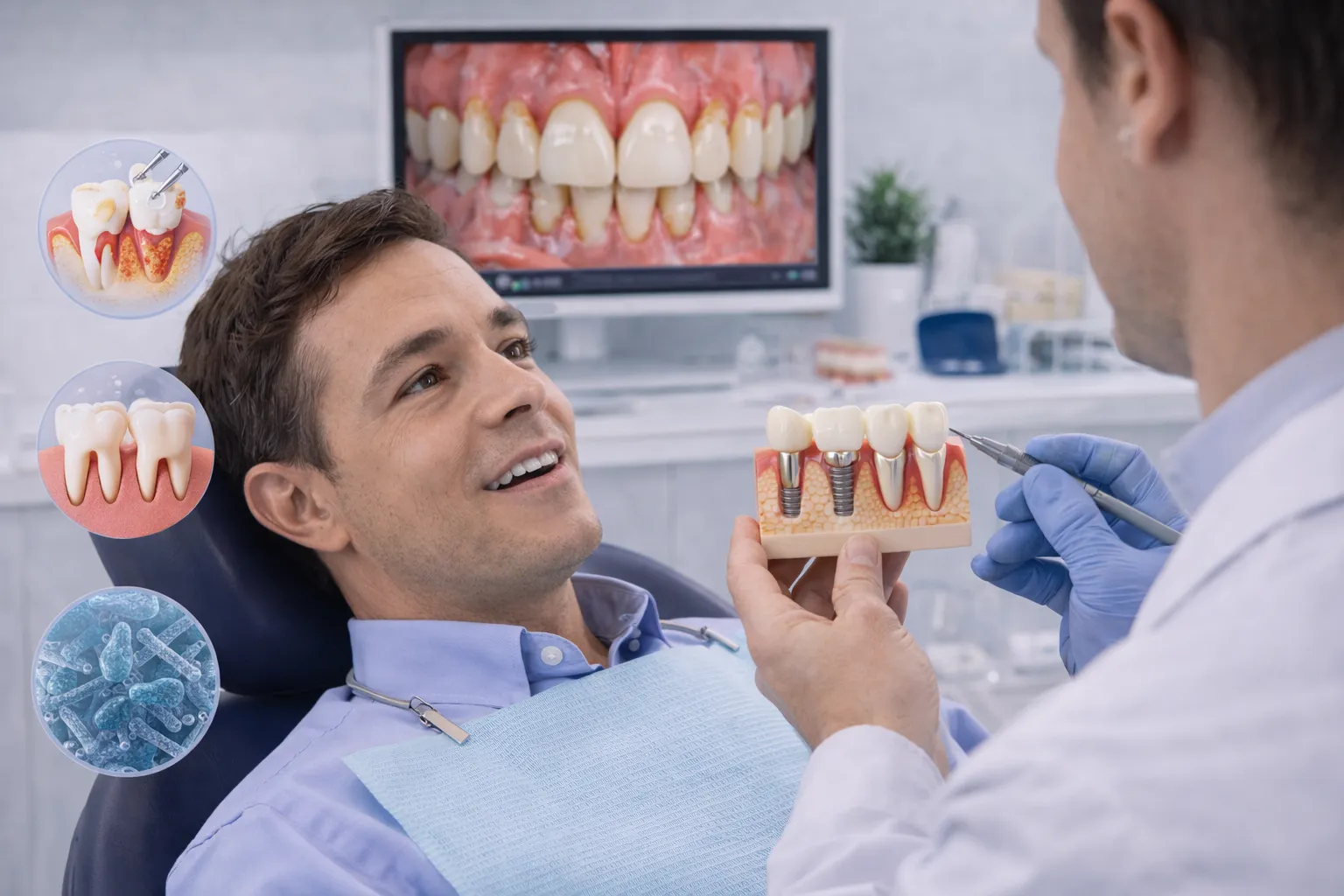
Stages of Gum Disease
Gum disease does not stop at a single point; it progresses in stages if left untreated. Intervention is possible at every stage; however the earlier the disease is treated, the higher the recovery.
| Stage | Condition | Symptoms | Treatment |
|---|---|---|---|
| Healthy Gum | No inflammation | Pink, firm, no bleeding | Prophylaxis + hygiene education |
| Gingivitis | Superficial inflammation (reversible) | Redness, swelling, bleeding on brushing | Scaling + good hygiene |
| Early Periodontitis | Mild bone loss beginning | Bleeding, mild pocket formation (3–4 mm) | Curettage (closed) + hygiene |
| Moderate Periodontitis | Noticeable bone loss | Deepening pocket (4–6 mm), tooth mobility | Curettage + supportive treatments |
| Advanced Periodontitis | Severe bone loss, risk of tooth loss | Deep pocket (6+ mm), tooth migration, abscess | Periodontal surgery / bone graft |
Scaling (Debridement) and Prophylaxis
Bacterial plaque accumulating on tooth surfaces and at the gum-tooth border mineralizes over time to form hard tartar (calculus). These layers, which cannot be removed by home brushing, are the primary trigger of gum disease. Professional cleaning is performed with ultrasonic devices and hand instruments.
Tartar above the gum line and on visible surfaces is removed with an ultrasonic device. The procedure is painless; completed in 30–60 minutes. Bleeding and swelling generally subside within a few days.
Tartar below the gum line (inside the pocket) is removed with hand instruments and fine-tipped ultrasonic devices. Local anaesthesia can be applied if there is significant build-up.
After cleaning, tooth surfaces are polished with a special paste and rotating brush (prophylaxis). Superficial stains are removed; the smoothed surface makes plaque adhesion more difficult. Recommended for coffee, tea and smoking stains.
Twice a year if low risk; every 3–6 months if gum disease is present or rapid tartar build-up occurs. Regular cleaning largely prevents the development and progression of gum disease.
Curettage (Root Surface Planing / Deep Scaling)
Curettage is a periodontal treatment applied in moderate-to-advanced gum disease where pockets have deepened and superficial cleaning alone is insufficient. Bacteria, tartar and inflamed soft tissue below the gum line are removed with special curette instruments; the root surface is smoothed.
Curettage stops the progression of gum disease; however it does not restore lost bone or receded gum. For this reason, intervention before the disease progresses is extremely important.
Periodontal Surgery and Bone Regeneration
In advanced gum disease, periodontal surgery may be required in deep pockets where curettage is insufficient or in cases of significant bone loss.
- Flap operation: The gum is opened for cleaning of deep pockets; the root surface and bone area are cleaned under direct vision. Closed with sutures.
- Bone graft (regeneration): Synthetic, heterologous or autogenous bone material is placed in areas of bone loss to support new bone formation. Used to prevent tooth loss and in preparation before implant placement.
- Guided bone regeneration (GBR): A membrane is used together with bone graft to protect the bone area; gum tissue is prevented from growing ahead of the bone.
- PRF (Platelet Fibrin): Growth factor concentrate obtained from the patient's own blood is used in combination with surgical procedures to accelerate healing and support bone regeneration.
Gingival Recession Treatment
Gingival recession is the condition in which the tooth root becomes visible. It creates both an aesthetic problem and exposes the root surface to sensitivity and decay. Brushing pressure, bruxism, periodontitis and thin gum biotype are the main causes.
Peri-Implantitis Treatment
Peri-implantitis is bacterial inflammation of the gum and bone around an implant. It is defined as the implant version of periodontitis. If left untreated, it leads to bone loss and implant failure.
Peri-implantitis is much harder to treat than to prevent. Daily floss/superfloss use, oral irrigator and 6-monthly professional check-ups largely prevent it.
Gummy Smile Treatment – Excessive Gum Visibility
When the gums are more visible than normal when smiling, it is called a "gummy smile." With the gums in the foreground, teeth appear short or small. Different treatment methods are applied depending on the cause.
| Cause | Treatment Method | Description |
|---|---|---|
| Excess gum tissue (hyperplasia) | Gingivectomy / Laser contouring | Excess gum tissue is removed surgically or with laser; teeth appear longer |
| Upper lip elevating excessively | Masseter/upper lip Botox | Lip-elevating muscles are temporarily relaxed; gum visibility is reduced |
| Dental alignment disorder | Orthodontics + laser combination | Aesthetic contouring added if necessary after correcting tooth position |
| Short lower jaw (skeletal cause) | Orthognathic surgery assessment | Surgical assessment; planned if other methods are insufficient |
Correct treatment selection depends on determining the source of the gummy smile. At our clinic, the root cause is identified following examination and the appropriate option is recommended.
Pink Aesthetics – Gum Aesthetics
White teeth are only half of a beautiful smile. Without symmetrical, healthy pink gums, even the best veneer or restoration cannot provide complete aesthetics. Pink aesthetics applications complete smile design by correcting the gum line.
Frenectomy – Tongue and Lip Tie Operation
The frenum (tie) is the connective tissue that attaches the tongue or lip to the jawbone. When this tie is shorter or thicker than normal, it can negatively affect speech, feeding, dental health and aesthetics. The tie is corrected with a small surgical operation called a frenectomy.
Connection Between Gum Health and Systemic Diseases
Periodontal disease is not limited to the mouth. Chronic inflammation and the mixing of periodontal bacteria into the bloodstream can affect many systemic conditions.
Periodontal bacteria and chronic inflammation are associated with atherosclerosis risk. Antibiotic prophylaxis before dental procedures may be required in patients with heart valve disease.
While diabetes intensifies gum disease, chronic gum inflammation negatively affects blood sugar control. A bidirectional relationship exists; gum treatment can improve HbA1c values.
Hormonal changes during pregnancy increase gum sensitivity. Untreated periodontal disease has been associated with low birth weight and preterm birth risk.
The bacterial load in the mouth can reach the lungs through aspiration. Can increase COPD and pneumonia risk profile. Oral hygiene is a priority for those with systemic disease.
As bone mineral density decreases, the jawbone can also be affected. It is critical for osteoporosis patients using bisphosphonates to consult their physician before tooth extraction.
Chronic stress increases gum inflammation via cortisol. Stress management, regular sleep and balanced nutrition also support periodontal health.

Dr. Sevgi Savaş Akbaş
Dentist · Periodontology · Pink Aesthetics · Gummy Smile · Ankara İncekDr. Sevgi Savaş Akbaş comprehensively addresses gum diseases at her Ankara İncek clinic — from scaling and curettage to periodontal surgery and bone regeneration, and from gingival recession treatment to peri-implantitis management. Gummy smile, pink aesthetics applications and frenectomy are planned as complementary components of aesthetic smile design. Each patient's systemic condition is incorporated into the periodontal treatment plan.
Periodontology – Frequently Asked Questions
Is gum bleeding dangerous?
Is curettage painful?
Do teeth look longer after curettage?
Why does gummy smile occur and how is it treated?
Can pink aesthetics be planned together with veneer?
Does gingival recession reverse?
Is frenectomy surgery risky?
Does periodontitis heal completely?
Can diabetics have gum treatment?
I have had an implant — why should I continue gum check-ups?
Why Sevgi Savaş Dental Clinic in Ankara İncek for gum treatment?
Book an Appointment for Your Gum Health
Have a periodontal assessment at our Ankara İncek clinic for bleeding, recession, sensitivity or gummy smile concerns. Healthy gums are the foundation of strong teeth and an aesthetic smile.
Call Now WhatsApp Ankara Dental Clinic