Ankara İncek · Surgery
Dental Surgery
Tooth extraction, impacted wisdom tooth, cyst, apical resection, sinus lifting and bone graft. From simple extraction to advanced implant surgery under one roof.
20–30 minImpacted tooth operation time
7–10 daysSoft tissue healing time
Same SessionExtraction + immediate implant option
PainlessComfortable process with local anesthesia
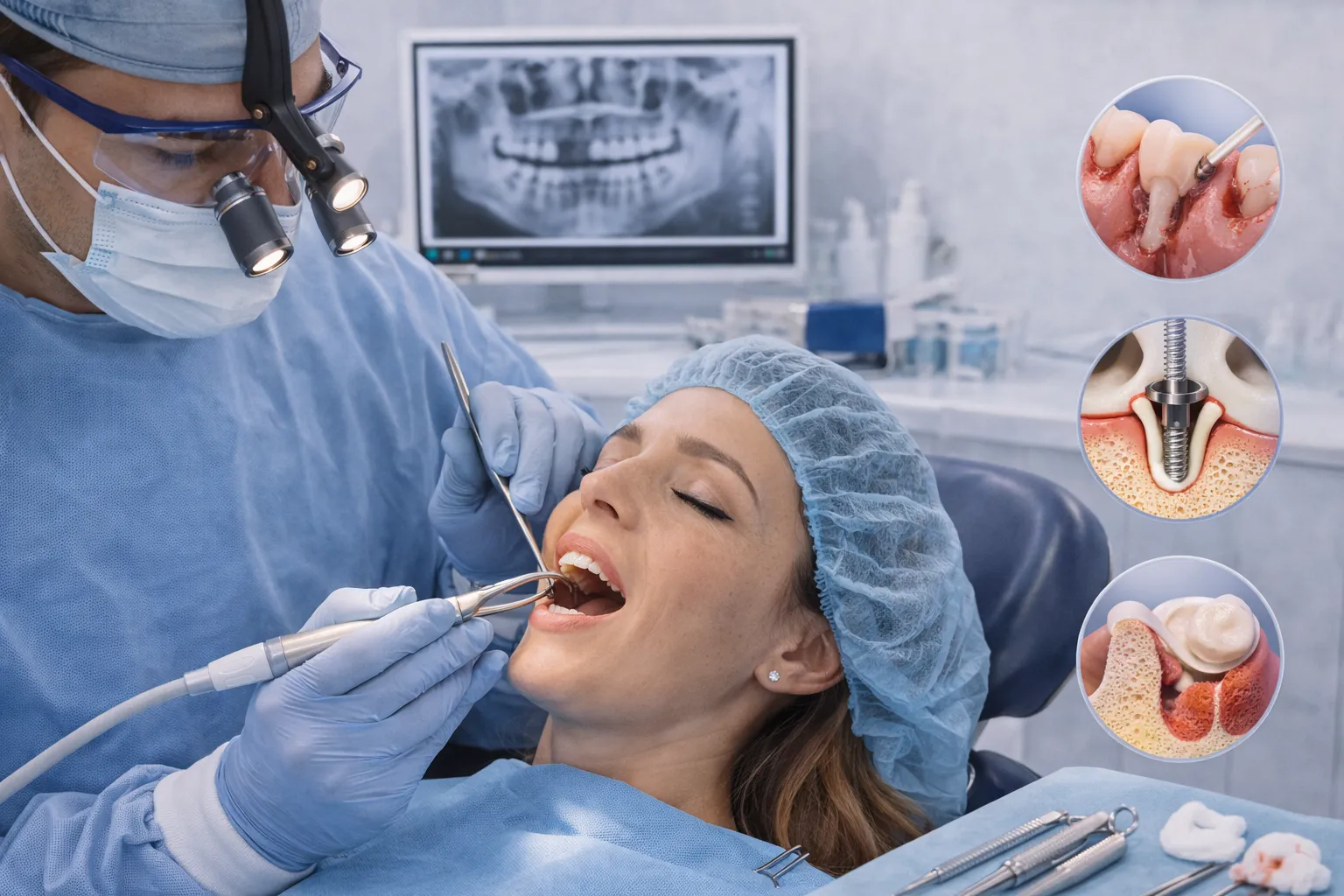
Dental surgery covers a wide range of surgical treatments from simple tooth extraction to advanced implant operations, from cyst treatment to apical resection. Correct planning, up-to-date imaging and a minimally invasive approach directly determine both the safety and patient comfort of surgery. At our clinic, all surgical procedures are performed under local anesthesia, guided by digital imaging and 3D tomography when necessary; the healing process is optimized with biological support agents such as PRF.
Tooth Extraction
Tooth extraction is a surgical procedure performed painlessly and safely under local anesthesia. Advanced decay, irreparable damage, requirements to create space in the jaw, or end-stage gum disease are the main indications for extraction.
Extraction IndicationsAdvanced decay (unrestorable) · Loose tooth due to bone loss · Fractured root · Orthodontic space creation · Preparation before prosthesis or implant · Preventing spread of infection
Application ProcessLocal anesthesia is applied · Tooth is loosened with "luxation" movements without affecting the mucosa · Removed with the principle of minimal trauma · Closed with sutures if necessary · Completed within 15–30 minutes
First Hours After ExtractionGauze bitten for 30 minutes forms a clot · Hard food and smoking prohibited for first 24 hours · Cold compress (first 48 hours): 15 min per hour · Rinsing the mouth and using straws must be avoided to protect the clot
Implant After ExtractionWith the "immediate implant" method, extraction + implant in the same session is possible. Suitability depends on bone quality and absence of infection. Each case is evaluated individually at our clinic.
Impacted Wisdom Tooth Surgery
Wisdom teeth (3rd molars), when there is insufficient space in the mouth, remain fully or partially impacted or attempt to erupt from an angled path. This situation creates a basis for serious problems such as pressure on neighboring teeth, decay, inflammation and abscess.
When Is Extraction Required?
Fully impacted: Cyst formation or pressure on neighboring tooth · Partially impacted: Recurring pericoronitis (hood inflammation) · Angled eruption: Risk of decay in adjacent tooth · Abscess under the gum · If it causes a space problem during orthodontic treatment
Operation Process
Local anesthesia · Minimal incision to the gum · Bone removal (ostectomy) if necessary · Tooth is removed; sectioned if necessary · Closure with sutures · Duration: 20–45 minutes · Mild pain and swelling for 2–4 days after anesthesia wears off
Swelling Is Normal — Cold Compress Should Be AppliedCheek swelling after the operation is expected. Cold compress should be applied intermittently for 15 minutes during the first 48 hours. Swelling usually subsides in 5–7 days; call the clinic for pain or fever that persists beyond 48 hours or worsens.
Complex Tooth Extraction
Some teeth cannot be removed with standard methods. Fractured or curved root structures, fusion of the root with bone (ankylosis), instruments broken inside the tooth or remaining root fragments due to deep decay require complex extraction.
- Surgical incision: A small flap is made in the gum to provide direct access to the root structure.
- Ostectomy: If the root covered by bone requires it, a small bone removal procedure is applied.
- Odontectomy: The tooth is removed by dividing it into multiple pieces rather than one large piece; surrounding tissue is preserved.
- Sutures: The surgical site is closed with appropriate closure sutures; generally removed in 7–10 days.
Complex extraction may require slightly longer healing time compared to simple extraction; however, with correct planning a comfortable operation process is experienced.
Cyst Surgery
Jaw cysts can form around impacted teeth (dentigerous cyst), at the root tip (radicular cyst) or spontaneously. As they grow, they can push neighboring tooth roots and resorb the jawbone; painlessly growing cysts may progress unnoticed for a long time.
Enucleation (Cyst Removal)
Most common method · Cyst sac is removed intact · Preferred for small-medium cysts · If necessary, cyst is removed together with the neighboring tooth · Removed tissue is sent for pathological examination
Marsupialization
Instead of direct removal in large cysts, an opening is created in the cyst wall · Allows the cyst to drain into the mouth and shrink on its own · Enucleation can be planned in a second stage · Minimizes bone loss
If cyst cavities are large, they are supported with bone graft; this accelerates refilling of the bone and preserves structural strength. Routine pathology follow-up is performed after cyst surgery.
Apical Resection (Root-End Resection)
In root canal-treated or retreated teeth, root tip infection may persist. In apical resection, the tooth is preserved rather than extracted; the infected root tip (1–3 mm) and surrounding inflamed tissue are surgically removed, and the root tip is retrofilled (in reverse direction) to ensure a seal.
Indications
Root tip inflammation not responding to repeat root canal treatment · Cyst or granuloma at the root tip · Broken canal instrument (non-retrievable piece) · Excessive filling overshoot · Cases where canal anatomy makes retreatment impossible
Advantages
Tooth is preserved; extraction not required · Crown or existing restoration on the tooth continues to be used · High success rate in suitable cases · Can be combined with bone graft · Healing supported with PRF
Sinus Lifting (Sinus Augmentation) Operation
When bone resorption occurs in the posterior upper jaw region due to prolonged tooth loss, the distance to the sinus floor becomes insufficient for implant placement. With sinus lifting surgery, the sinus membrane is elevated; bone graft is placed in the created space to obtain sufficient height for the implant.
Closed Sinus Lifting
Can be applied if bone height is between 5–8 mm · While opening the implant socket, the sinus membrane is elevated with an osteotome · Bone graft is injected · Implant can be placed in the same session · Less invasive; faster healing
Open Sinus Lifting (Lateral Window)
Applied if bone height is below 5 mm · A small window is opened in the lateral wall; membrane is elevated · Bone graft is placed · Implant is placed 4–6 months later · Greater volume increase possible
Bone Graft and Guided Bone Regeneration (GBR)
The jawbone that has become insufficient due to cyst, extraction, trauma or prolonged edentulism can be supported with bone graft before implant treatment or gum surgery.
Autogenous Bone GraftBone pieces taken from the patient's own body (usually from the jaw region). Highest success rate; however requires an additional surgical site.
Allograft / XenograftBank bone (processed human or animal-sourced) is used. Does not require additional surgery; can be applied in various particle sizes.
Synthetic Graft (Alloplast)Completely artificial material; carries no infection risk whatsoever. Effective in closeable cavities, post-cyst defects.
GBR MembraneBarrier membrane used together with bone graft. Guides regeneration by preventing soft tissue from growing ahead of the bone.
PRF (Platelet-Rich Fibrin)Growth factor concentrate prepared from the patient's own blood. When added to the surgical site, it accelerates tissue healing; provides biological resistance against infection.
Ridge Expansion (Split Crest)In thin jawbone, before opening the implant socket, the ridge is split and expanded; graft is placed in between. The implant is placed once the bone is strengthened.
Post-Surgery Care and Healing
| Period | What to Do | What to Avoid |
|---|
| First 24 Hours | Bite gauze for 30 min · Cold compress 15–20 min at intervals · Soft foods · Take prescribed medications regularly | Rinsing the mouth · Using a straw · Smoking · Excessive physical activity |
| Days 2–3 | Warm salt water rinse (after 24 hours) · Continue soft foods · Continue brushing teeth (except surgical area) | Smoking (disrupts clot) · Alcohol · Hard foods |
| 1st Week | Follow antibiotic + painkiller schedule · Swelling starts to decrease · Follow-up appointment (sutures on days 7–10) | Checking the suture area with tongue or finger · Sports · Exercise |
| 2nd Week and After | Gradual return to normal diet · Gentle cleaning with soft toothbrush · X-ray check-up if necessary | Continuing to smoke reduces long-term implant success |
ALVEOLITIS (Dry Socket) – Emergency SignIf the post-extraction clot is disrupted, "alveolitis" (dry socket) can develop. Symptoms: severe pain beginning to increase on days 3–5 after extraction, bad breath and absence of a clot. Risk factors: smoking, straw use, rinsing the mouth. If symptoms appear, contact the clinic immediately; the wound heals quickly with dressing treatment.

Dr. Sevgi Savaş Akbaş
Dentist · Surgery · Sinus Lifting · Bone Graft · Ankara İncek
Dr. Sevgi Savaş Akbaş performs a wide range of surgical treatments at her Ankara İncek clinic — from simple tooth extractions to complex impacted tooth operations, from apical resection to advanced implant surgeries such as sinus lifting and bone grafting. In operations performed under the guidance of digital imaging and 3D tomography, the healing process is optimized with biological support agents such as PRF.
Dental Surgery – Frequently Asked Questions
Is tooth extraction painful?
No pain is felt during the procedure thanks to local anesthesia. After the anesthesia wears off, mild pain and sensitivity may occur for a few days; this is controlled with prescribed painkillers. Most patients find tooth extraction much more comfortable than they expected.
Does a wisdom tooth always need to be extracted?
Not every wisdom tooth requires extraction. If it has fully and properly erupted, hygiene can be maintained and it is not damaging neighboring teeth, it can be monitored. If it is impacted, angled, or causing recurring inflammation, extraction is recommended. The decision is made with panoramic X-ray assessment.
Can I have an implant placed at the same time as extraction?
Yes, with the "immediate implant" method this is possible if the bone is suitable. The bone quality must be sufficient and there must be no active infection in the area. This method offers a single-session solution; it shortens the treatment period. Your suitability is determined at the clinic through clinical and tomographic assessment.
What is alveolitis (dry socket) and how is it prevented?
Alveolitis is a painful complication that occurs when the post-extraction clot is disrupted early. The main triggers are smoking, straw use and rinsing the mouth. To prevent it, smoking should be avoided, straws should not be used and the mouth should not be rinsed for the first 24–48 hours. If it develops, it heals quickly with dressing treatment.
What kind of damage can a cyst cause in the jaw?
Jaw cysts grow painlessly, pressing on neighboring tooth roots, causing teeth to shift position and resorbing the jawbone, potentially increasing the risk of fracture. Early surgical treatment is recommended, considering the risk of pathological transformation. Removed tissue is sent for pathological examination.
Is sinus lifting painful and how long does it take?
No pain is felt during the operation under local anesthesia. Closed sinus lifting passes with much less swelling and pain compared to the open technique. Healing time is approximately 2–3 days for the closed technique and 1–2 weeks for the open technique. Smoking negatively affects the success and healing of the operation.
Is bone graft a risky procedure?
Bone grafting performed with modern materials is a routinized, safe procedure. The risks are no different from other minor surgeries: infection, slow healing. Sterile conditions, appropriate material selection and adherence to post-surgical care minimize the risk. If there is no pathological bone, the success rate is high.
Does apical resection replace root canal treatment?
No. Apical resection is applied to save a tooth that has had root canal treatment but still has ongoing infection at the root tip. It comes into play in cases where standard root canal treatment is insufficient, retreatment is not possible, or in special cases such as a broken instrument. Its purpose is to preserve the tooth rather than extract it.
What does PRF (Platelet-Rich Fibrin) do?
PRF is a growth factor-dense biological material obtained from the patient's own blood by centrifuge method. When placed in the surgical site, it accelerates tissue healing, supports bone regeneration and provides biological resistance against infection. It contains no foreign substances; there is no risk of rejection.
Why is smoking harmful after surgery?
Smoking significantly increases the risk of alveolitis by disrupting the post-extraction clot; it slows tissue healing by reducing oxygen levels in the surgical area. After implant surgery, smoking directly reduces osseointegration success. Avoiding smoking for at least 48–72 hours is recommended, and quitting is advised in the long term.
Why Sevgi Savaş Clinic in Ankara İncek for surgical treatment?
At our clinic, all procedures from tooth extraction to advanced surgical applications such as sinus lifting and bone grafting are planned under the guidance of digital imaging and 3D tomography when necessary. With PRF biological support and the immediate implant option, both a comfortable process and rapid healing are targeted.
Book an Appointment for Surgical Assessment
For impacted tooth, swelling, pain or pre-implant preparation, have a detailed examination at our Ankara İncek clinic; let the most appropriate surgical plan be created for you.
Call Now
WhatsApp
Ankara Dental Clinic

